


Fermentation Knowledge
Why does natural fermented chili sauce not need preservatives?
Jul
“No preservatives but lasts for 18 months – I don’t believe it!”. That was a message Spico once received from a customer.
At first, this suspicion is completely understandable. Today, many people are used to the idea that for food to last long, it must contain preservatives. No preservatives means it will spoil in just a few days.
In fact, thousands of years ago, when our ancestors did not know about “industrial preservatives,” they still knew how to preserve food for a long time, such as fish sauce, pickled vegetables, fermented shrimp paste, traditional soy sauce… And the interesting truth that few people know is – what helped these foods last long was the natural fermentation process.
The same goes for chili sauce. Spico does not use preservatives but still extends the shelf life up to 18 months. So how does natural fermented chili sauce work? Let’s find out in this analysis.
What is Fermentation?
Fermentation is a natural phenomenon that has existed in human life for a long time, mainly occurring in daily foods. During fermentation, beneficial bacteria, mainly from the Lactobacillus group, use natural sugars in the raw ingredients to produce lactic acid. This lactic acid makes the environment more acidic.
Interestingly, most bacteria that spoil food cannot grow in a high-acid environment. In other words, good bacteria create a “natural protective barrier,” helping food stay preserved longer without chemical preservatives.
This principle is not new. It is the secret behind famous dishes around the world like: Kimchi from Korea; Sauerkraut from Germany; Traditional pickled vegetables from Vietnam; Aged soy and fermented sauces. Natural fermented chili sauce operates on the exact same principle.
Instead of just grinding ingredients and bottling them immediately, fresh chilies undergo controlled fermentation to create a naturally stable environment. As a result, the product has better shelf life and develops complex layers of flavor that ordinary chili sauce can hardly match.
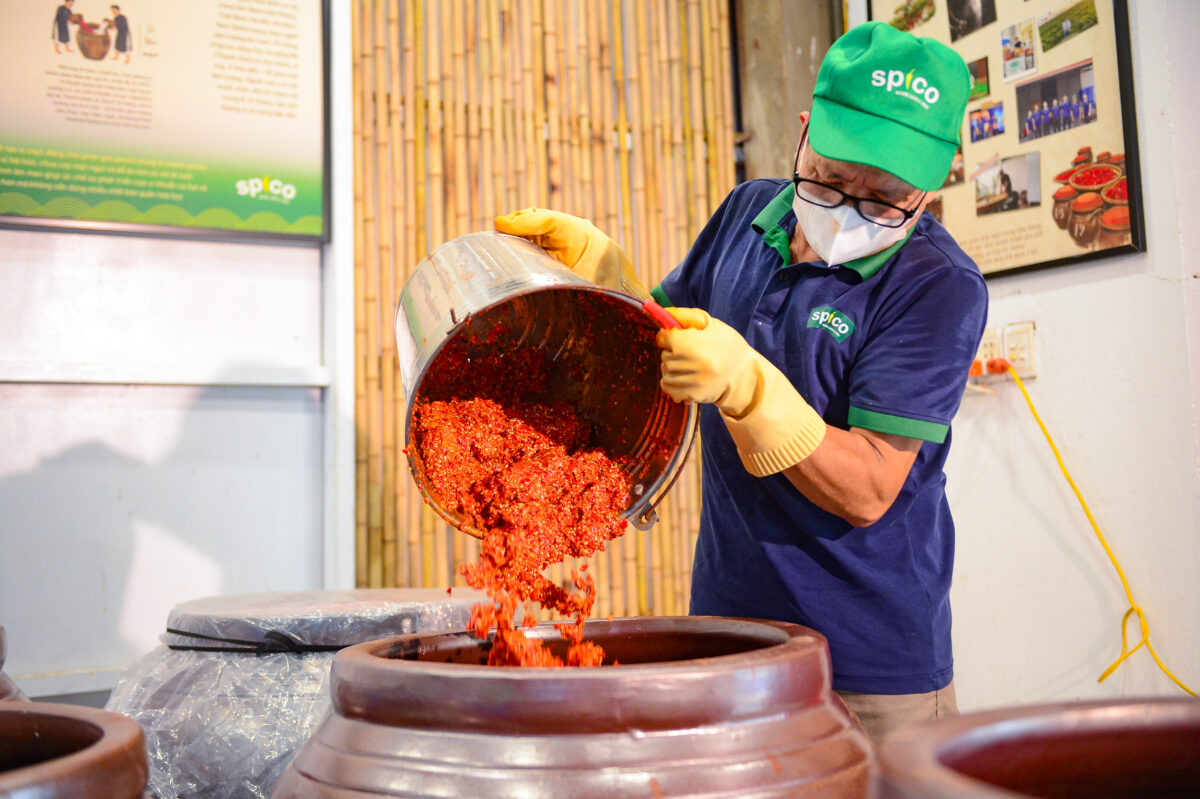
Why does aging in clay jars create a difference in flavor?
From the outside, clay jars look simple. But their structure brings many special advantages to the fermentation process.
The wall of the clay jar contains countless micro air pores invisible to the eye. These air pores allow the food to “breathe” very gently, creating favorable conditions for beneficial microorganisms to work stably.
In addition, clay jars absorb and release heat more slowly than modern materials like plastic or metal. This helps the temperature inside the jar stay more stable, limiting sudden changes that can affect fermentation.
The results are:
– Beneficial bacteria grow more easily.
– The conversion process takes place slowly and deeply.
– More layers of flavor are formed.
– The spiciness becomes more balanced.
– The natural acidity is more balanced.
In particular, prolonged fermentation also helps create natural umami – a rich taste often described as “deliciously deep,” leaving a long-lasting aftertaste that lets diners feel the richness in every drop of chili sauce.
This is also why many people, when trying fermented chili sauce for the first time, often comment that the flavor is “rounder,” not just simply hot and sour.
How long does natural fermented chili sauce last?
This is probably the question our customers care about the most.
For products fermented correctly, packed sanitarily, and unopened, the standard shelf life is 12 to 18 months.
During this time, the natural acid environment formed from the fermentation process continues to keep the product stable.
However, after opening the lid, the chili sauce will be exposed to air and microorganisms from the external environment.
At this point, to ensure the best flavor quality, you should:
– Close the lid tightly after each use.
– Store in the refrigerator.
– Use within about 30–45 days after opening.
This is a simple but effective way to preserve the characteristic flavor of fermented chili sauce.
How is natural fermented chili sauce different from industrial chili sauce?
On the market today, many industrial chili sauces use preservatives like sodium benzoate to extend shelf life. This method keeps the product stable quickly.
In contrast, Spico’s natural fermented chili sauce relies on the beneficial microbial system, lactic acid created during fermentation, and the pasteurization method during bottling to preserve the product.
While industrial chili sauce usually focuses on spicy, sweet, or sour taste adjusted with industrial additives, natural fermented chili sauce brings layers of flavor that develop over time, creating a richer and deeper taste when enjoyed.
When hearing about the fermentation method, many people think of it as a new trend. But in fact, this is one of the food preservation methods that humans created thousands of years ago. Without synthetic preservatives, nature has created an extremely smart mechanism: using good bacteria to protect food from harmful bacteria.
So – “Can a product without preservatives last for 18 months?” – The answer is “Yes”.
Spico invites you to explore our chili products to experience the spicy, rich, and authentic taste created by time, ingredients, and traditional fermentation art.


